

The Beginnings: Football Before Official Recognition
The history of Sweden's women's national football team began long before its first officially recognised international match in 1973. During the 1960s, women's football was gradually gaining popularity across Sweden, although opportunities remained limited and the sport received little recognition from established football authorities. Despite these obstacles, women began organising teams and arranging matches, including encounters against international opposition.
One of the earliest examples came in 1964, when a team from Löberöd in the southern Swedish region of Skåne faced a Danish side assembled from players representing several clubs. The Danish team won 7–0, highlighting the considerable gap in experience between the two sides. Although the match was not an official international, it represented an early attempt by Swedish women to compete against foreign opposition.
In May 1968, another Swedish representative team travelled to Denmark to face Femina, one of the country's established women's football clubs. The Swedish side, composed of students from Lund University, was described in contemporary newspapers as a "Swedish national team", despite having no official recognition. Before the match, the players had received coaching from a Swedish male footballer with experience at the highest domestic level and in the national team. However, the more experienced Danish opponents proved too strong, winning 7–0.
The following year, in 1969, a team consisting of players from Skåne was selected to represent Sweden in a tournament in Denmark, where they faced opposition from Denmark and Czechoslovakia. These early encounters demonstrated the growing ambition of Swedish women's football, even though the teams lacked the organisation, resources and official status of a recognised national side.
While the results often reflected Denmark's greater experience in women's football, these pioneering matches were important steps towards establishing Sweden's own national team. They provided opportunities for international competition and helped lay the groundwork for the official national team that would eventually make its debut in 1973.

1970–1971: Unofficial Internationals Against Denmark
By the beginning of the 1970s, Swedish women's football had developed sufficiently for representative teams to compete more regularly against foreign opposition. Between 1970 and 1971, Swedish teams played several unofficial international matches against Danish opposition. The Swedish squads were primarily assembled from clubs in Skåne, Västergötland and the Stockholm region.
Denmark was already one of the leading nations in women's football. Danish teams had participated in unofficial international tournaments, and Denmark won the unofficial Women's World Cup in Italy in 1970. Sweden's encounters with its Scandinavian neighbour therefore provided an early indication of the difference in experience between the two countries.
One particularly notable meeting came during qualification for the unofficial 1971 Women's World Cup. Sweden suffered a 5–0 defeat against Denmark, highlighting the challenges facing a team still in the early stages of its development. Another encounter in Copenhagen attracted approximately 6,400 spectators. Denmark won the closely contested match 4–3, but the occasion demonstrated that women's international football could attract substantial public interest.
Although these matches are not included in Sweden's official international records, they remain an important part of the national team's history. They provided valuable experience for Swedish players and helped establish the idea of a national side representing the country on the international stage.
1973: Sweden's First Official International Match
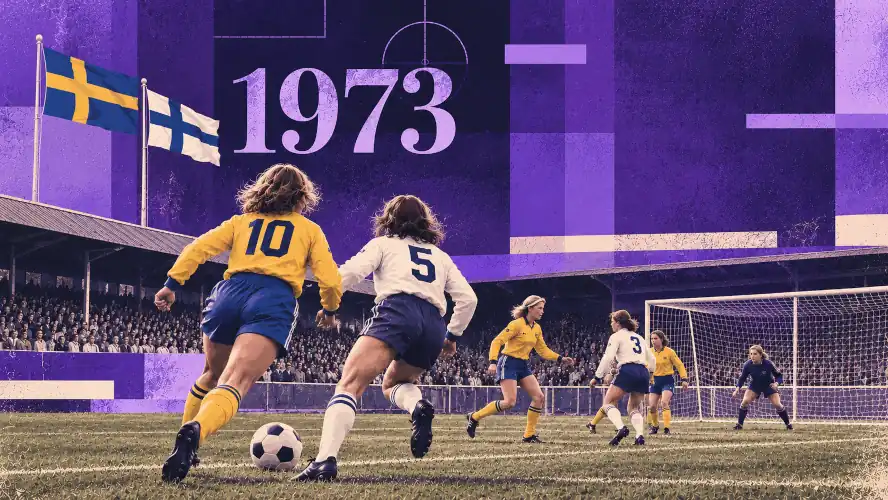
On 25 August 1973, Sweden's women's national team finally made its official international debut. The opponents were Finland, and the match took place at Mariehamns IP on the Åland Islands, an autonomous region of Finland. For the Swedish players, the occasion marked an important milestone. After years of unofficial matches and limited institutional recognition, Sweden now had a formally recognised women's national football team.
The team was coached by Christer Molander and captained by 37-year-old Ebba Andersson, who became the first official captain in the national team's history. The squad included several players who had helped establish women's football in Sweden, including Ann Jansson, Gun Hellestig, Susanne Erlandsson and Agneta Björck.
Despite the historic occasion, the conditions surrounding the team remained modest. The players received little financial support and had to balance their football commitments with work, education and everyday responsibilities. Nevertheless, the match attracted 1,540 spectators and was broadcast live on Finnish television. On the pitch, Sweden and Finland played out a goalless draw.
The 0–0 result may have appeared unremarkable, but its historical significance was considerable. It marked the beginning of Sweden's official women's international football history.
1974–1976: Establishing a National Team
Following its official debut, Sweden began playing international matches more regularly. In 1974, the first Nordic Women's Football Championship was organised, featuring Sweden, Denmark and Finland. The competition provided an important opportunity for the three nations to develop their national teams through regular international football. Denmark won the inaugural championship, with Sweden finishing second and Finland third.
On 26 July 1974, Sweden recorded its first official international victory, defeating Finland 1–0 in Mariehamn. It was a significant achievement for a team that had played its first recognised match less than a year earlier. Sweden continued to develop throughout the following seasons, gradually expanding its international experience beyond Scandinavia.
In June 1975, Sweden defeated England 2–0 at Ullevi in Gothenburg, in front of nearly 3,000 spectators. The victory was an important indication of Sweden's growing competitiveness. Later that year, Sweden travelled to England and secured another impressive result, winning 3–1. The team also enjoyed success against Finland, recording a 4–0 victory in July 1975 and a 2–0 win the following month.
However, Denmark remained a difficult opponent. Sweden suffered a 3–0 defeat in July 1975 and lost another meeting 1–0 in 1976. The mixed results reflected the challenges of building a competitive national team in a sport that was still developing internationally. Yet each match contributed to Sweden's progress, providing players with experience and helping establish a more consistent national team structure.
1977: Sweden Claims Its First Nordic Championship
The year 1977 marked a turning point in Sweden's early international history. After finishing behind Denmark in previous Nordic Championships, Sweden finally emerged as the region's leading team. The championship was held in Finland, where Sweden opened its campaign with a convincing 4–0 victory over the hosts on 8 July.
The following day, Sweden faced Denmark in a decisive encounter. Denmark had been one of the dominant forces in early women's international football, and defeating them represented an important challenge for the Swedish side. Sweden secured a narrow but historic 1–0 victory, claiming its first Nordic Championship title.
The achievement demonstrated how far the national team had progressed since its unofficial encounters with Danish opposition earlier in the decade. Sweden was no longer simply attempting to establish itself internationally. It was beginning to compete successfully against some of the strongest teams in European women's football.
1978–1979: A Growing Force in Women's Football
Sweden built on its breakthrough success in the following two years. At the 1978 Nordic Championship in Denmark, Sweden continued its strong form, defeating Norway 2–1 and drawing 0–0 with Finland. A decisive 1–0 victory over Denmark secured another Nordic title, confirming Sweden's growing dominance in the region.
The team also demonstrated its attacking potential outside Nordic competition. In October 1978, Sweden travelled to Switzerland and recorded an emphatic 7–1 victory. By this stage, Sweden had developed a stronger and more experienced national team, with players increasingly accustomed to international competition.
The emergence of young talents was also becoming an important part of the team's development. Among them was Pia Sundhage, who made her international debut in 1975 as a teenager. Her technical ability and attacking qualities would eventually make her one of the most important players in Swedish football history.
Sweden's progress continued in 1979. At the Nordic Championship in Norway, Sweden defeated Denmark 4–1 and Norway 1–0 before drawing 1–1 with Finland. These results secured a third consecutive Nordic title. Later that month, Sweden participated in international matches in Italy, facing several European opponents.
The team defeated Wales 3–0, drew 1–1 with the Netherlands, lost 1–0 to Denmark and recorded an exciting 4–3 victory over England. These encounters demonstrated that Sweden was becoming increasingly competitive against a wider range of European national teams. By the end of 1979, Sweden had established itself as one of Northern Europe's strongest women's national sides.
The Pioneers Who Built a National Team
The development of Sweden's women's national team during the 1960s and 1970s was driven by players who competed under conditions very different from those experienced by later generations. They often received little financial compensation, had limited access to professional coaching and training facilities, and competed in a sport that was still struggling for widespread recognition.
Despite these obstacles, the early Swedish internationals helped establish a national team that would eventually become one of the most respected in women's football. The unofficial representative teams of the late 1960s and early 1970s provided the first international experiences, while the official national team formed in 1973 created a foundation for continued development.
Players such as Ebba Andersson, Ann Jansson, Susanne Erlandsson and Pia Sundhage helped bridge the gap between the sport's pioneering era and its emergence as an established international competition. By the end of the decade, Sweden had won three consecutive Nordic Championships and demonstrated that it could compete successfully against leading European opponents.
The achievements of these early generations laid the groundwork for the successes that would follow during the 1980s, including Sweden's historic first European title in 1984.

From unofficial matches against Denmark to three consecutive Nordic titles, the years before 1980 transformed Sweden from an emerging football nation into one of the pioneers of international women's football.