
1980–1982: A New Era for the National Team
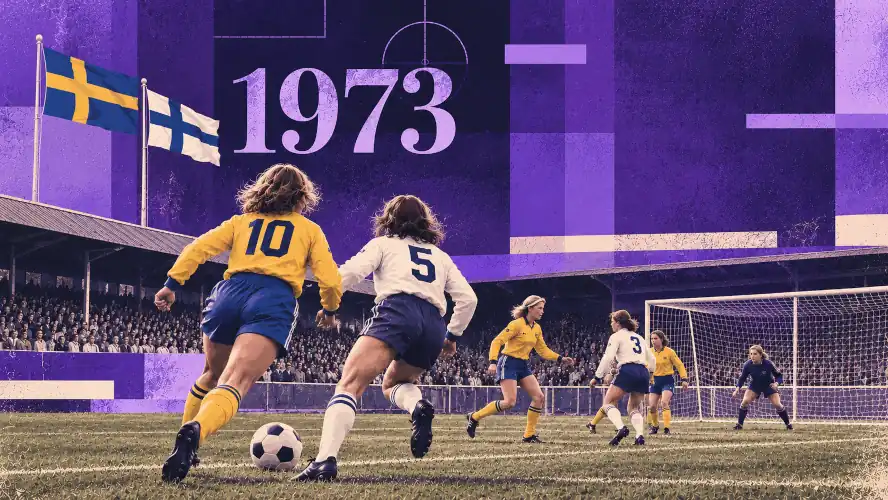
At the beginning of the 1980s, Sweden's women's national football team was entering a new phase of its development. The pioneering years of the previous decade had laid a strong foundation. Sweden had played its first official international match in 1973, gained experience against European opponents and won three consecutive Nordic Championships between 1977 and 1979. However, international women's football was still developing. There was no FIFA Women's World Cup, and European national teams had yet to compete in a UEFA-organised continental championship.
In 1980, Ulf Lyfors became Sweden's national team coach. He inherited an increasingly experienced squad, with several players already established at international level and younger talents beginning to emerge. Among the most important was Pia Sundhage, who had made her international debut in 1975. A gifted attacking player, Sundhage combined technical ability, creativity and an instinct for scoring important goals. Other established figures included defender Anette Börjesson, goalkeeper Elisabeth Leidinge and midfielder Ann Jansson, all of whom would play important roles in Sweden's greatest achievement of the decade.
The national team continued to compete regularly against Nordic opposition while preparing for a significant development in European women's football. In 1982, UEFA launched its first European competition for women's national teams, officially known as the European Competition for Representative Women's Teams. For the first time, Sweden had the opportunity to compete for a continental title in a structured UEFA tournament. It would prove to be a historic opportunity.
1982–1984: The Road to European Glory
The inaugural European competition began in August 1982, with 16 participating nations divided into four qualifying groups. Sweden was drawn alongside Finland, Norway and Iceland. The Swedish team began its campaign in emphatic fashion, defeating Finland 6–0 away from home on 18 August 1982. It was the opening match of the entire competition and an early indication of Sweden's ambitions. Under Lyfors, Sweden dominated its qualifying group, winning all six matches and securing a place in the semi-finals.
The results demonstrated that Sweden had developed into a formidable international side, combining experienced leadership with a talented attacking lineup. In the semi-finals, Sweden faced Italy, one of the more established nations in European women's football. The first leg took place in Rome on 8 April 1984. In front of approximately 10,000 spectators, Sweden secured an important 3–2 away victory. Three weeks later, the teams met again in Linköping. Sweden won 2–1, completing a 5–3 aggregate triumph and advancing to the final. Standing between Sweden and the first European title was England.
1984: The Historic European Championship Victory
The final of the inaugural European competition was played over two legs, with Sweden hosting the opening match at Ullevi in Gothenburg on 12 May 1984. A crowd of 5,662 spectators watched the Swedish team attempt to take an advantage into the return leg. The match remained goalless until the 57th minute, when Angelica Burevik delivered a cross from the left and Pia Sundhage headed the ball into the net. Sundhage's goal gave Sweden a 1–0 victory and put the team within reach of becoming Europe's first women's national champions.
The decisive return match was played at Kenilworth Road in Luton on 27 May. Conditions were extremely difficult. Heavy rain had left the pitch muddy and slippery, turning the encounter into a physical contest in which maintaining possession and creating chances became increasingly challenging. England equalised the aggregate score when Linda Curl scored in the first half. Neither side managed to find another goal, leaving the final tied 1–1 on aggregate. The European title would be decided by a penalty shootout.
Sweden's goalkeeper, Elisabeth Leidinge, played a crucial role, saving one of England's attempts. With the shootout still undecided, Pia Sundhage stepped forward to take Sweden's final penalty and converted. Sweden had won the shootout 4–3 and become the first champions of UEFA's European women's national team competition. Captain Anette Börjesson lifted the trophy, completing a remarkable journey for a national team that had played its first official international match only eleven years earlier.
The triumph represented the greatest achievement in Swedish women's international football to that point. It also marked the emergence of several players who would become enduring figures in the national team's history. Pia Sundhage finished as the leading scorer of the final tournament with four goals, while the defensive leadership of Börjesson and the goalkeeping performances of Leidinge proved equally important. For Sweden, the victory was more than a trophy. It demonstrated that the country could compete successfully at the highest level of European women's football.
The Stars Behind Sweden's Golden Generation
Sweden's success during the 1980s was built around a generation of players whose contributions helped define the national team. While the European title was a collective achievement, several individuals became particularly important to the team's identity and international reputation.
Pia Sundhage – The Attacking Star
Pia Sundhage was arguably the most influential Swedish player of the decade. Having made her international debut as a teenager in 1975, she developed into the central figure in Sweden's attack during the 1980s. Sundhage possessed a rare combination of technical skill, vision and composure in front of goal. She could create opportunities for teammates while also deciding matches herself.
Her performances during the 1984 European Championship established her reputation internationally. She scored the winning goal in the first leg of the final against England and converted the decisive penalty in Luton. Sundhage would remain a key figure for Sweden well beyond the 1980s, eventually becoming one of the most celebrated players in the history of women's football.
Anette Börjesson – The Captain and Defensive Leader
Anette Börjesson was the captain of Sweden's European championship-winning team in 1984. A commanding defender, Börjesson provided leadership and stability at the heart of the Swedish defence. Her importance extended beyond individual performances. As captain, she helped guide a squad competing in the first major European tournament of its kind.
The image of Börjesson lifting the European trophy in 1984 became one of the defining moments of Swedish women's football. She continued to represent Sweden during the following years, remaining an important member of the national team as it sought to defend its European title.
Elisabeth Leidinge – The Goalkeeper Who Helped Secure History
Elisabeth Leidinge, widely known by her nickname "Lappen", was another central figure in Sweden's golden generation. A reliable and experienced goalkeeper, she provided confidence behind the Swedish defence. Her most memorable international moment came during the 1984 European final against England.
In the decisive penalty shootout, Leidinge saved an English penalty, helping create the opportunity for Sweden to claim the title. Her contribution became an essential part of the story of Sweden's first European championship victory.
Lena Videkull – The Emerging Goalscorer
While Sundhage was already an established star, Lena Videkull emerged as another major attacking talent during the decade. Videkull made her senior international debut in 1984 and quickly developed into an important goalscoring presence. Known for her finishing ability and intelligent movement, she complemented Sundhage's creativity and gave Sweden another dangerous attacking option.
Her importance grew during the second half of the 1980s, and she would become one of the national team's most prolific goalscorers. Together, Sundhage and Videkull formed an attacking partnership that would remain significant as Sweden entered the 1990s.

1985–1987: Defending the European Crown
After the triumph of 1984, Sweden entered the next European championship cycle as defending champions. The success brought new expectations. Sweden was no longer simply an emerging force in women's international football; it was the team that other European nations hoped to defeat.
Qualification for the 1987 European competition began later in 1984, with Sweden facing the Netherlands, Belgium and France. The Swedish side continued to perform strongly, winning five of its six qualifying matches and finishing top of its group. The final tournament was held in Norway in June 1987, bringing together Sweden, Norway, England and Italy.
Sweden faced England in the semi-finals, renewing the rivalry that had produced the dramatic final three years earlier. Once again, the encounter proved closely contested. Sweden eventually secured a 3–2 victory after extra time, earning a place in its second consecutive European final. The opponents were hosts Norway, who had become one of Sweden's strongest international rivals.
The final took place in Oslo on 14 June 1987. Norway took the lead through Trude Stendal, who scored twice to put the hosts in control. Lena Videkull pulled a goal back for Sweden, but the defending champions were unable to find an equaliser. Norway won 2–1, ending Sweden's reign as European champions.
Although the defeat was disappointing, reaching another European final confirmed Sweden's position among the strongest national teams in women's football. The rivalry between Sweden and Norway was also becoming one of the defining contests in European women's football.
1988: A World Tournament Before the World Cup
In 1988, Sweden participated in a landmark international tournament that would help shape the future of women's football. FIFA organised an invitational competition in China, bringing together twelve national teams from six continental confederations. The tournament was designed to assess the feasibility of establishing an official Women's World Cup, something that had not yet been introduced.
Sweden entered the competition as one of Europe's strongest teams. Under head coach Gunilla Paijkull, the squad included established stars such as Pia Sundhage, Elisabeth Leidinge and Lena Videkull, alongside players including Ingrid Johansson, Marie Karlsson and Eva Zeikfalvy.
Sweden progressed through the tournament and reached the final, where it faced familiar rival Norway. The Norwegian team secured a narrow 1–0 victory, leaving Sweden as runners-up. Although Sweden missed out on the title, finishing second in a competition featuring teams from around the world represented another major international achievement.
The tournament also had significance beyond the results. Its success helped convince FIFA that a global women's championship was viable, paving the way for the inaugural FIFA Women's World Cup in 1991. For Sweden, the experience provided an important opportunity to compete against opponents from outside Europe and prepare for the next stage of international women's football.
1988–1989: A Changing European Landscape
The final years of the decade brought further changes to the Swedish national team. Women's international football was becoming increasingly competitive, with more nations developing stronger teams. Sweden remained among Europe's leading sides, but the gap between the established powers was narrowing.
Following the 1987 European final, Sweden began qualification for the 1989 tournament. The team faced the Netherlands, the Republic of Ireland and Scotland in the qualifying stage, eventually progressing to a two-legged quarter-final against Denmark. A commanding 5–1 victory away from home gave Sweden a decisive advantage. A 1–1 draw in the return leg secured a place in the final tournament in West Germany.
The 1989 competition marked another important chapter in Sweden's history. It was also a period of transition in the national team's leadership. Gunilla Paijkull had succeeded Ulf Lyfors as head coach in 1988, becoming the first woman to lead Sweden's women's national team.
At the tournament, Sweden once again faced Norway in the semi-finals. The Norwegians prevailed 2–1, denying Sweden a third consecutive appearance in the European final. Sweden still had an opportunity to finish the competition with a victory. In the third-place match against Italy, the Swedish team recovered from a difficult position and eventually secured a 2–1 win after extra time.
The result earned Sweden third place and ensured that the national team had finished among the top three in all three European competitions held during the decade.
1989: A Memorable Victory at Wembley
One of Sweden's most memorable international appearances of the late 1980s came outside the European Championship. On 23 May 1989, Sweden faced England at Wembley Stadium in London. The match was played as a curtain-raiser before the men's Rous Cup encounter between England and Chile, providing the Swedish women's national team with an opportunity to play at one of football's most famous venues.
Sweden produced an impressive performance, defeating England 2–0. Pia Sundhage opened the scoring in the sixth minute, becoming the first woman to score in a women's international match at Wembley Stadium. Lena Videkull added Sweden's second goal in the 58th minute, completing a memorable victory.
The occasion symbolised the national team's growing international standing. For a generation that had begun its international journey with limited resources and recognition, playing and winning at Wembley represented another significant milestone. It also highlighted the strength of Sweden's attacking partnership, with Sundhage and Videkull both finding the net.
A Decade That Defined Sweden's International Ambitions
By the end of 1989, Sweden's women's national football team had undergone a remarkable transformation. At the beginning of the decade, the team was an emerging international side seeking opportunities to compete against Europe's best. Ten years later, Sweden had become European champions, reached another continental final, finished runners-up in FIFA's 1988 invitational tournament and secured a third-place finish at the 1989 European Championship.
The achievements were driven by a talented generation of players, including Pia Sundhage, Anette Börjesson, Elisabeth Leidinge, Lena Videkull, Ann Jansson and Karin Åhman-Svensson. Under the leadership of Ulf Lyfors and later Gunilla Paijkull, Sweden developed the experience and confidence needed to compete consistently at the highest European level.
Yet the decade also revealed the challenges ahead. Norway had emerged as a formidable rival, while West Germany's victory at the 1989 European Championship signalled the arrival of another major force. The international landscape was changing, and Sweden would need to continue developing to remain competitive.
A new era was approaching. The first FIFA Women's World Cup would take place in 1991, offering Sweden and its rivals the opportunity to compete for a global title for the first time. The foundations for that challenge had been laid throughout the 1980s.
From the muddy pitch in Luton to the historic victory at Wembley, the 1980s transformed Sweden's women's national team into European champions and established a legacy that would shape the generations to come.